
A MENTAL TIME DETERMINATION
By Klaus Hohlfeld
Dear Fritz,
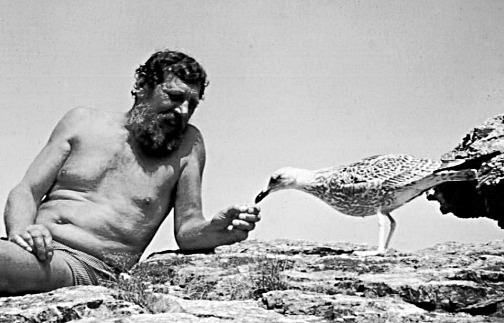
You ask me what I think of your intention – after a life of renouncing any form of public self-presentation – to photograph your paintings and gather them in a kind of œuvre catalogue. I now ask myself: what were your motives, and what was the reason for this motivation? In 1960 you went to Elba and built “your” house – almost without outside help. Hardly was it finished when you built two guest houses, in the same way. So from the very beginning you knew that you wanted to isolate yourself in surroundings of your own choosing, and you knew that you would invite the “world” to be your guest, not the other way round. Your conscious life was built upon this clarity of self-chosen conditions. This decision and resolve is – so I believe – not to be understood from an individual disposition, but must be seen against the historical background: our generation, those born around 1930, came out of darkness and a chaotic “nowhere”. Worse still: this “nothing”, the horrific Hitler era, had not only isolated us from everything and withheld everything from us, it had also cruelly stained us. Then the paralysis of the post-war years during our adolescence, the hunger, the lack of intellectual life: no teachers. How does one find one’s way in all that – how does one find one’s way to oneself?
You decided clearly, very early and with great trust in your own powers: through independent, uninfluenced, continuous and calm thinking, listening into your own ground and questioning the world; in your case, the great panorama of an infinite, Mediterranean nature. You did this unchallenged and undisturbed by the noisy and ever more grandiosely surging world of the metropolises. Facing a “great” nature, before a wide horizon and the reflections of azure spaces, your easel stood on the cliffs of this infinite island, and you began – in your own way – to survey it.
When, around 1970, the new social ideas and individual paths to salvation branched out everywhere, they also left their traces on the island. Like hashish smoke, those utopias hung over those who debated and cast their spell. You were the rock around which these wild waters swirled in the summers, before they flowed back north in the autumn – not without claiming victims and leaving unpleasant flotsam behind. Your anchor ropes held. Your fortress, built of your house, your garden, your painting and the will to simplicity, straightness and reliability, withstood the onslaught of the Zeitgeist. Unswervingly you remained true to yourself and your resolutions, thereby setting a remarkable example against all the allurements, objections and temptations of the time. Your place was and remained Elba.
In the paintings you made, one increasingly saw not only essential abstractions of a rich morphological view of nature, but manifestations of inner states and conditions of the soul that captivated the viewer. Among the people who visited you or were your guests, many were impressed not only by your way of facing life, but increasingly also by these pictures. Through sales you were able to live your independent, free life; their recognition and admiration was enough for you to pursue your path unswervingly. For the painter, that meant submitting only to his own law, not to that of a “market”; remaining in the context of nature and not getting lost in his own signets. All this you decided with great clarity and did without compromise. As a record of your reflections there is an œuvre in which the toils of life have been transformed into art. In the paintings these processes have become visible as an independent correspondence of form, which recoins the sensory stimuli of a concrete landscape situation into an example of “nature” in the comprehensive sense: a nature grasped not from the outside, but from its constituting power, its creating forces.
These forces, which in the play of appearances exert such a beneficent and moving effect on us, are captured through painterly creative processes that correspond to them and, beyond simple depiction, show the creation of nature from within: its becoming out of form. And since insight into the coherence of nature always shows itself in painting through the handling of the means – that is, technique – the old-masterly mixed technique of tempera underpainting and glaze beneath the final layer of varnish finds a logical and wholly independent continuation in the surfaces of these pictures.
How independently of all contemporaneity this painterly form is worked out is shown by the fact that this world appears not as modelled from outside, but as hurled up by volcanic forces from great depths – not placed into the light, but created out of light.
The joy one feels when looking is not so much the joy of the eye in appearance, but a joy of the spirit and of insight into a being that is true, mighty and beautiful.
It is entirely understandable that you now wish to gather and present this design of a world as a contribution to a mental determination of the time.
I see in this neither a breach of faith nor a deviation from the path; rather, in my eyes the structure of your life thereby finds its logical, conclusive form, and what drove you – a good end.
I congratulate you from the heart.
Berlin, November 2002 · Klaus Hohlfeld (painter)